Cooling & Airflow
How to Improve Airflow in a Bedroom

A bedroom can feel cold, hot, stale, or humid simply because air does not move through it well.
Airflow diagnosis table
| Problem | Likely cause | Check | Fix |
|---|---|---|---|
| Weak vent air | Blocked register, filter, damper, duct issue | Tissue at vent | Open vent, clear furniture, request HVAC check |
| Room stale with door closed | No return path | Door open test | Door gap, transfer grille, fan assist |
| Hot ceiling, cold floor | Poor mixing | Temperature at floor and head height | Low-speed fan circulation |
| Stuffy after sleeping | Low fresh air exchange | Morning odor and humidity | Ventilate and improve return path |
Step-by-step checks
- Open the supply register fully and remove obstructions.
- Check whether the room has a return grille. If not, test with the door open.
- Clean the register grille and replace accessible HVAC filters.
- Move tall furniture away from airflow paths.
- Measure temperature and humidity before and after changes.
Fan placement that actually helps
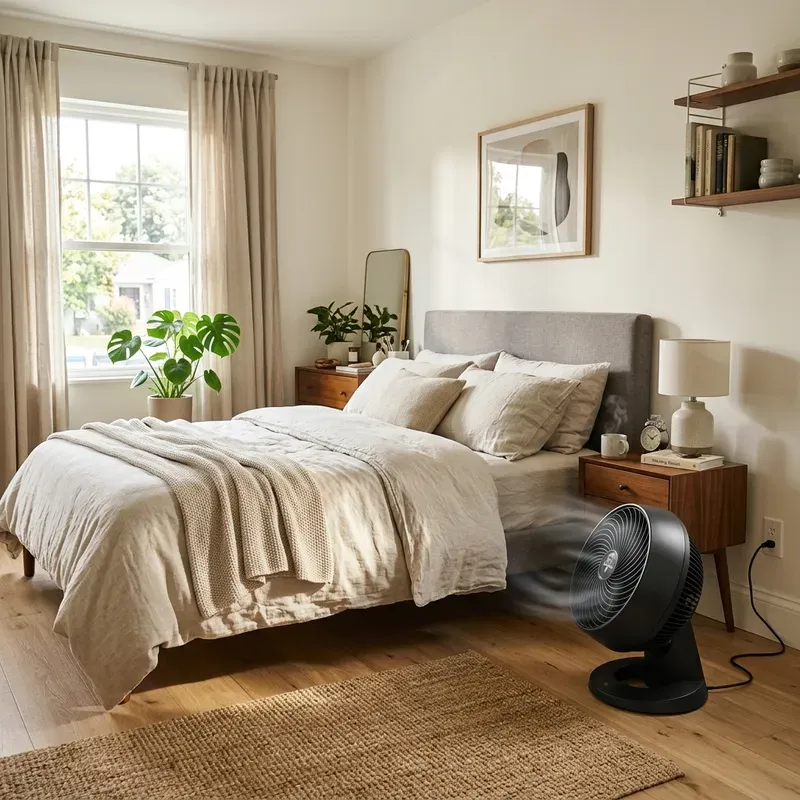
For stale rooms, place a fan near the doorway to push air out of the bedroom so replacement air can enter. For uneven temperature, use a low fan speed to mix the room without creating a chilly draft.
Renter-friendly fixes
- Use door stops to keep airflow paths open.
- Try a quiet doorway fan or small circulation fan.
- Use vent deflectors only if they do not block airflow.
- Ask maintenance about weak vents or closed dampers.
When it is an HVAC issue
If the supply vent is weak compared with other rooms or the room never catches up, the system may need balancing, duct repair, or return-air improvements.
My experience improving bedroom airflow
In a railroad apartment bedroom, the room felt stuffy every morning even with the vent open. The real issue was a closed door trapping return air. Leaving the door open four inches during heat and AC cycles changed comfort more than buying a second fan.
I also had a dresser blocking half the floor register. Moving it cost nothing and raised airflow enough that the room matched the hallway temperature within twenty minutes.
FAQ
Does a fan improve airflow or just move hot air?
A fan can improve mixing and move air between rooms, but it cannot fix a blocked duct or missing return path.
Should bedroom doors stay open?
If there is no return grille, an open door can help air leave the room when HVAC runs.
Can furniture block airflow?
Yes. Beds, curtains, and dressers can stop supply air from mixing into the room.
Why is my bedroom stuffy but the hallway is fine?
The bedroom may lack a return path, especially when the door is closed.
When should I call HVAC?
Call if airflow is weak, noisy, or unchanged after basic checks.
Practical airflow checks before adding cooling
A hot or stuffy room is not always short on cooling equipment. It may have blocked supply air, no return path, too much sun, poor fan placement, a portable AC vent leak, or a door that traps warm air. Check airflow and heat gain before buying a larger unit.
| Check | Why it matters | Low-risk first move |
|---|---|---|
| Door open vs closed | Shows whether return airflow is restricted | Compare temperature after a cooling cycle |
| Vent strength | Weak supply air can make one room lag | Clear furniture and check filter |
| Sun exposure | Glass can add heat faster than AC removes it | Close curtains before direct sun hits |
| Fan direction | Fans can mix air or move heat the wrong way | Place fans to move air toward an exit path |
Renter note
Renters should focus on reversible airflow changes: clear vents, adjust curtains, improve fan placement, seal portable AC panels, and document large temperature gaps. Avoid wiring, duct, or window modifications without permission.
When not to DIY
Call for help if the system short cycles, vents have almost no airflow, breakers trip, ducts are damaged, or the room remains far hotter than nearby rooms after basic checks.
Field notes: How to Improve Airflow in a Bedroom
This section adds the decision detail most short guides skip: what to measure, what to try first in a real flat, and when to stop and escalate. It is written for apartments and rentals where permanent renovation is not an option.
Cooling sequence that beats random gadget buys
Order matters: stop solar gain → fix portable AC vent leaks → clean filters → cool a closed zone → only then upsize BTUs. A loosely fitted window plate can erase most of the cooling you paid for.
Fans cool people, not rooms, unless they exhaust hot air when outdoor conditions help. Night flush works when outdoor air is cooler and not swampy; humid heat waves need a different plan than dry nights.
| Mistake | What happens | Fix |
|---|---|---|
| Long hose loops | Heat dumps back | Short, sealed, insulated run |
| Open-plan hopes | One small unit fights whole flat | Close doors; zone first |
| Dirty filter | Weak output + ice risk | Clean on schedule |
| Ignoring afternoon glass | Room pre-heats | Blackout / reflective film by day |
Lease-safe boundaries
Photograph anything you change. Prefer screw-free or fully reversible products on painted surfaces. Ask in writing before altering entry doors, fire doors, or shared building components. Stop for gas smells, electrical faults, active leaks, or large mold — those are not DIY content problems.
When this page is not enough
If symptoms stay extreme after basic checks — room far outside the rest of the home, water damage, combustion appliance concerns, breaker trips — document conditions and contact a qualified professional or building management. Dwell Calm is informational, not a substitute for HVAC, electrical, mold, or legal advice.
Door undercut check
If closing the bedroom kills supply feel, you may be starving the return path. A planned gap or jumper strategy beats forcing a sealed “quiet” door that traps heat and CO₂ feel.
Extra practical detail: how to improve airflow bedroom
Treat this guide as a field procedure: observe, change one thing, wait, and record outdoor conditions. If the whole flat fails the same way, escalate to building maintenance with measurements. If only one room fails, stay local — drafts, glass, vents, or moisture at that room’s surfaces.
Keep fixes reversible in rentals. Stop for gas, electrical, flooding, or large mold issues and get qualified help.
Follow-up checks
Revisit this problem after weather changes. A fix that works on a calm day may fail on a windy night. Keep a short note of what you installed and when you removed seasonal products.
If you email support or your landlord, include the room, the symptom time of day, and one photo. Clear packets get faster answers.
Related guides
 How to Keep a Room Warmer Without Turning Up the HeatLow-cost and renter-friendly ways to keep a room warmer by reducing drafts, improving airflow, using curtains,...
 Mold Prevention in Apartments: What You Can ControlLearn the basics of mold prevention in apartments, including humidity control, condensation checks, airflow an...
 Normal Room Humidity: Ideal Indoor Humidity Levels by Season and RoomLearn ideal room humidity levels by season and room, warning signs of high or low humidity, how to measure wit...
 Why Is My Portable AC Not Cooling the Room?Troubleshoot a portable AC that is not cooling, including hose setup, BTU sizing, window kit gaps, filters, si...
Sources
About Emma Collins
Home comfort editor and home wellness advocate with 10 years helping families create calm, functional spaces. Emma created Dwell Calm to share practical, renter-friendly home comfort advice.
Learn more about Emma ->